

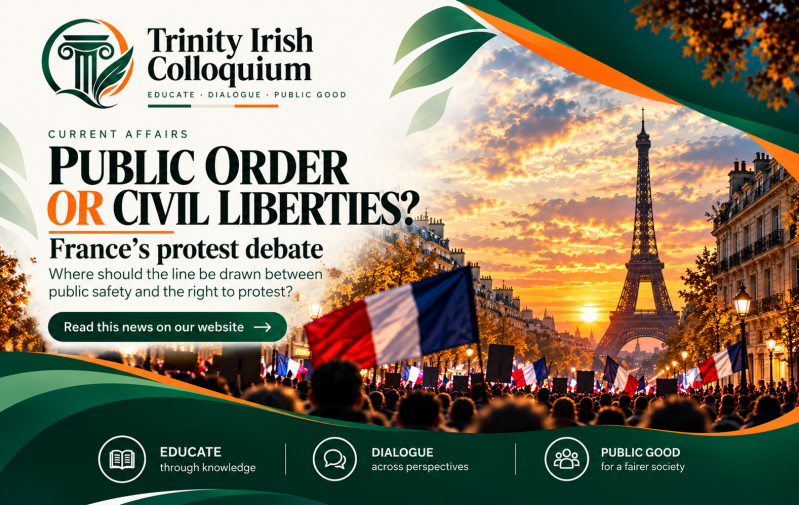
Protest is an essential feature of democratic life. It allows citizens to express dissatisfaction, challenge government decisions, and demand political or social change.
In France, where public demonstrations have a long-standing place in political culture, debates about protest frequently raise a fundamental question: how can a state maintain public order while protecting civil liberties? The issue extends beyond France. Across democratic societies, governments face the responsibility of protecting public safety while ensuring that people can exercise their fundamental rights without unnecessary interference. The challenge is not simply to prevent disorder but to establish when state intervention is justified and how it can remain consistent with democratic principles.
The Democratic Importance of Protest
The freedom to protest enables individuals and communities to participate in public affairs beyond elections. Demonstrations can bring attention to issues that might otherwise receive limited political consideration, encourage public debate and hold institutions accountable.
Peaceful assembly also has a collective dimension. It allows people to express shared concerns, demonstrate solidarity and make their views visible to decision-makers. For minority groups and individuals with limited access to traditional political channels, public protest can be particularly important.
In France, demonstrations form part of a broader tradition of civic participation. However, the significance of protest does not mean that every restriction is automatically illegitimate, nor does it mean that public authorities can disregard the rights of demonstrators whenever difficulties arise.
The central question is how democratic institutions can protect the freedom to demonstrate while addressing genuine risks to the public.
Public Order and the Responsibilities of the State
Maintaining public order is a legitimate responsibility of government. Authorities must protect demonstrators, bystanders, emergency services, businesses and public infrastructure. They may also need to respond to violence, threats or circumstances in which public safety is seriously endangered.
Nevertheless, the concept of public order must be applied carefully. If interpreted too broadly, it can become a justification for restricting demonstrations simply because they are politically controversial, disruptive or inconvenient.
A democratic approach requires a distinction between peaceful dissent and violent conduct. The fact that a demonstration criticises the government, attracts a large crowd or causes temporary disruption does not, by itself, establish that it should be prohibited.
Restrictions should be grounded in law, supported by a legitimate objective and proportionate to the circumstances. Authorities should consider whether less restrictive measures could address the identified risk before resorting to more intrusive interventions.
Civil Liberties and the European Human Rights Framework
Freedom of expression and freedom of peaceful assembly are protected under the European Convention on Human Rights.
Article 10 protects freedom of expression, while Article 11 protects freedom of peaceful assembly and association. These provisions are particularly important when individuals express political opinions, organise demonstrations or participate in collective action.
Neither right is absolute. Restrictions may be permissible under the conditions established by the Convention, including requirements relating to legality, legitimate aims and necessity in a democratic society.
The European Court of Human Rights has emphasised the importance of protecting peaceful assembly and assessing state interference in its particular context. The authorities' obligations may include taking reasonable steps to facilitate peaceful demonstrations and avoiding unjustified interference with the exercise of fundamental freedoms.
At the same time, the protection afforded to peaceful assembly does not provide immunity for violence or other independently unlawful conduct. The legal assessment must distinguish between individual behaviour and the rights of other participants who remain peaceful.
This distinction is crucial: the actions of a few individuals should not automatically deprive an entire assembly of its protection.
When Does Policing Become Disproportionate?
The conduct of law enforcement is central to the relationship between public order and civil liberties. Police may be required to manage crowds, establish safety measures, prevent violence and respond to rapidly changing circumstances.
However, the use of police powers must remain subject to legal safeguards and accountability.
A careful assessment of policing during demonstrations should consider several questions:
-
Necessity: Was the intervention required to address a genuine and identifiable risk?
-
Proportionality: Was the level of force or restriction appropriate to the circumstances?
-
Differentiation: Did the authorities distinguish peaceful demonstrators from individuals engaging in violence?
-
Accountability: Were decisions properly documented and open to independent scrutiny?
-
Effective remedies: Could individuals challenge unlawful or disproportionate treatment?
These questions help move the debate beyond competing political narratives. The relevant issue is not simply whether police intervened, but whether the intervention was lawful, necessary and proportionate.
Public confidence in law enforcement depends not only on the ability to maintain safety, but also on the willingness of institutions to explain their decisions and investigate credible allegations of misconduct.
The French Debate in a Wider European Context
France's approach to demonstrations raises questions that are relevant throughout Europe. Governments must respond to changing security concerns, new forms of mobilization, and growing public expectations about institutional accountability.
At the same time, the digital environment has changed how protests are organised, reported and perceived. Images and videos can circulate rapidly, shaping public understanding before all relevant facts are established. Social media can increase transparency, but it can also encourage incomplete narratives and polarised interpretations.
These developments make reliable information particularly important. Assessments of a protest should distinguish verified facts from allegations, political commentary and speculation.
European democracies must also consider whether rules governing demonstrations are applied consistently. Restrictions that appear justified in one political context may raise serious concerns if comparable conduct is treated differently elsewhere.
Consistency, transparency and independent oversight are therefore essential to maintaining trust in democratic institutions.
Beyond the False Choice Between Freedom and Security
Public debate often presents civil liberties and public order as opposing objectives. This framing overlooks the possibility that they can reinforce one another.
Peaceful demonstrations are more likely to take place safely when clear rules exist, communication between organisers and authorities is effective, and police powers are exercised predictably and proportionately.
Similarly, public safety is strengthened when people trust that their rights will be respected and that complaints can be investigated fairly.
The objective should not be to eliminate all disruption associated with protest. Democratic participation may inevitably inconvenience others or challenge established political priorities. Instead, authorities should seek to prevent serious harm while preserving the space necessary for peaceful dissent.
A rights-based approach does not deny the state's responsibility to maintain order. It establishes the legal and democratic boundaries within which that responsibility must be exercised.
Questions for Democratic Society
The French protest debate invites several broader questions:
-
How should governments distinguish legitimate public-safety concerns from restrictions motivated by political pressure?
-
What safeguards are necessary to ensure that police powers remain proportionate?
-
How can democratic institutions protect peaceful demonstrators while responding effectively to violence?
-
What role should independent oversight, journalism and civil society play in scrutinising the state's response?
-
How can public authorities maintain trust among citizens who disagree with government policy?
These questions cannot be answered through slogans alone. They require careful legal analysis, reliable evidence and meaningful public dialogue.
Conclusion
The relationship between public order and civil liberties is one of the enduring challenges of democratic governance. France's experience provides a valuable context for examining how states can respond to public demonstrations while respecting the rights that give democratic participation its meaning.
The protection of public safety is essential, but it should not become an unrestricted justification for limiting peaceful dissent. Equally, the importance of civil liberties does not remove the need to address genuine threats to individuals and communities.
The appropriate balance must be guided by legality, necessity, proportionality and accountability. Ultimately, the strength of a democracy is demonstrated not only by how it manages disagreement, but also by how effectively it protects the right of people to express that disagreement peacefully.
Explore more commentary and educational content at trinityirishcolloquium.ie.
Trinity Irish Colloquium Committee
Add comment
Comments