

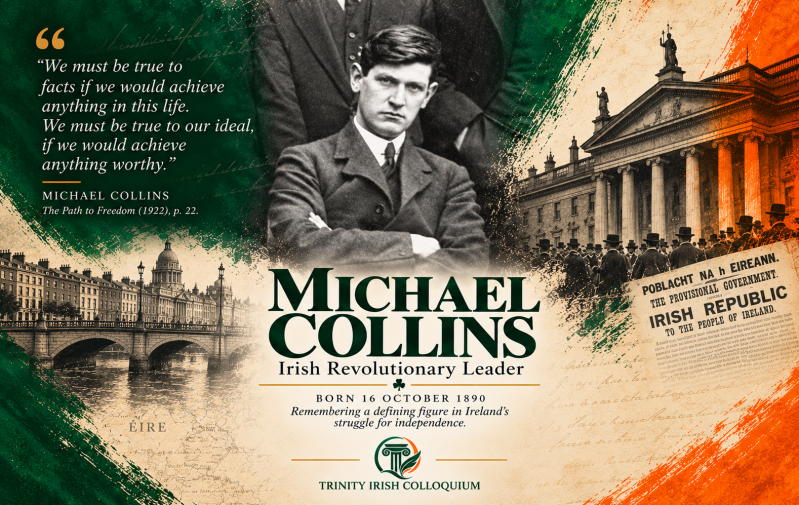
On 16 October 2026, we commemorate the 136th anniversary of the birth of Michael Collins (1890–1922), one of the most influential and consequential figures in Ireland’s struggle for independence. Born at Woodfield, near Sam’s Cross in West Cork, Collins would become a revolutionary, political strategist, military leader, and statesman whose brief life helped shape the course of modern Irish history.
Known affectionately as “The Big Fellow," Collins remains a compelling figure in Ireland’s national story: admired for his determination, organizational ability, and political courage, yet also remembered in connection with the difficult choices and divisions that accompanied the establishment of the Irish State.
Michael Collins was born into a farming family in rural County Cork. His early life in the Irish countryside helped shape his connection to the people, communities, and national aspirations that would later influence his political activities. In 1909, he joined the Irish Republican Brotherhood, a secret revolutionary organization committed to Irish independence.
His involvement in Irish nationalist circles brought him increasingly close to the movement that would challenge British rule in Ireland. By the time of the Easter Rising of 1916, Collins was working alongside leading revolutionaries, including Joseph Mary Plunkett. The Rising, although militarily unsuccessful, became a decisive turning point in the development of modern Irish nationalism.
Following the Rising and his imprisonment at Frongoch in Wales, Collins emerged as an increasingly influential organizer within the independence movement.
Collins’s influence extended well beyond the battlefield. Following the rise of Sinn Féin and the establishment of the First Dáil Éireann in 1919, he held important political responsibilities, including serving as Minister for Finance.
At a time when the revolutionary administration operated under considerable pressure, Collins helped organize financial resources and develop the institutions required to sustain the independence movement. He also became Director of Intelligence for the Irish Republican Army (IRA), coordinating intelligence networks and clandestine operations during the Irish War of Independence.
His ability to combine political organization, intelligence work, and military strategy made him one of the movement’s central figures. Rather than relying solely on public speeches or military action, Collins understood the importance of information, networks, financial resources, and effective administration in pursuing political objectives.
These qualities contributed to his reputation as one of the most capable and resourceful leaders of the revolutionary period.
One of the defining moments of Collins’s life came in 1921, when he joined the Irish delegation sent to London to negotiate an agreement with the British government.
The negotiations culminated in the signing of the Anglo-Irish Treaty on 6 December 1921. The agreement provided for the establishment of the Irish Free State, offering a substantial measure of self-government while retaining constitutional links with the British Crown and leaving the question of partition unresolved.
Collins supported the Treaty as a practical step towards greater Irish sovereignty. He understood the immense difficulties facing the delegation and the consequences that a renewed conflict could bring. Nevertheless, the agreement proved deeply controversial, dividing the independence movement and ultimately contributing to the outbreak of the Irish Civil War in 1922.
The Treaty illustrates the complexity of Collins’s legacy. His political choices cannot be separated from the circumstances in which they were made: a country emerging from conflict, competing visions of sovereignty, and the difficult question of whether a negotiated settlement could provide a foundation for further progress.
Following the establishment of the Provisional Government in 1922, Collins became its Chairman and later served as Commander-in-Chief of the National Army during the Civil War.
On 22 August 1922, while travelling through County Cork, he was killed in an ambush at Béal na Bláth by anti-Treaty forces. He was just thirty-one years old.
His death deprived Ireland of a prominent political and military leader at a critical moment in the formation of the new State. It also deepened the tragedy of a civil conflict in which former comrades and fellow supporters of independence found themselves on opposing sides.
Although Collins did not live to see the long-term development of the Irish State, his contribution to the independence struggle remains an important subject of historical study and public remembrance.
Collins’s writings and public statements reveal a leader concerned not only with political independence but also with the principles and practical realities necessary to achieve meaningful progress.
In The Path to Freedom (1922), the following passage is attributed to him:
“We must be true to facts if we would achieve anything in this life. We must be true to our ideal if we would achieve anything worthy.”
The passage brings together two ideas that remain relevant today: the importance of confronting reality honestly and the need to pursue principles that give political action a meaningful purpose.
For a historical figure whose career involved revolutionary struggle, difficult negotiations, and profound national divisions, these words offer a useful starting point for reflecting on the relationship between ideals, political judgement, and responsibility.
The legacy of Michael Collins is neither simple nor without controversy. His role in the independence movement, his support for the Treaty and his leadership during the Civil War continue to invite historical debate.
Yet his life also demonstrates the extraordinary pressures faced by those tasked with transforming a national movement into functioning political institutions. Collins combined revolutionary commitment with administrative ability, strategic thinking, and a willingness to engage in negotiations whose consequences would prove both far-reaching and deeply divisive.
His story reminds us that the history of Irish independence was shaped not only by battles and declarations but also by political decisions, negotiations, institutions and the people who sought to build a future amid uncertainty.
On the 136th anniversary of his birth, Trinity Irish Colloquium remembers Michael Collins as a defining figure in Ireland’s struggle for independence and an enduring part of the country’s historical heritage.
Trinity Irish Colloquium Committee
Add comment
Comments