

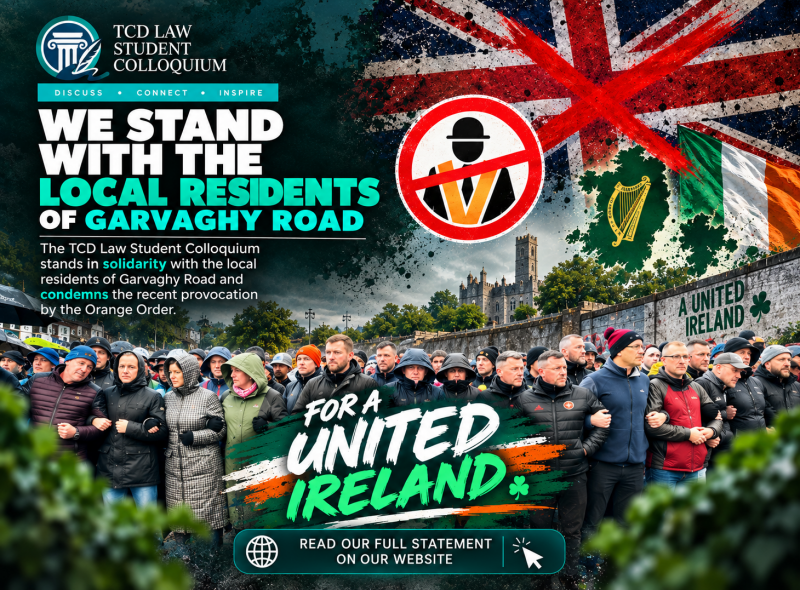
Colloquium stands in absolute and unqualified solidarity with the residents of Garvaghy Road and the wider Portadown community in the face of the renewed Drumcree parade controversy.
We write not as distant observers, but as students of law and history who understand that what is happening on Garvaghy Road is not an isolated administrative dispute. It is a confrontation with the unresolved legacies of colonialism, sectarian supremacy, and state-sanctioned violence legacies that threaten, once again, to drag communities back into a bloody past that was supposed to have been buried with the Good Friday Agreement.
What Has Happened
For almost three decades, the Orange Order has been prevented from marching along Garvaghy Road. This was not an arbitrary decision. It was the hard-won outcome of years of confrontation, terror, and suffering inflicted upon a nationalist community that was told, repeatedly, that its dignity was secondary to the "traditions" of another.
A few days ago the Northern Ireland Parades Commission authorized a limited return parade for the first time in 28 years. The residents of Garvaghy Road the people who actually live there, who raise their children there, who carry the living memory of what this parade has meant in the past said clearly and unequivocally: we do not consent.
The decision became the subject of urgent legal proceedings. On 26 September, a High Court judge temporarily suspended the parade, warning that the longstanding dispute had the potential to escalate. Following an unprecedented late-night appeal hearing, the Court of Appeal allowed the legal process to continue and the permission for the parade was ultimately restored. Today, crowds gathered on Garvaghy Road in opposition to the proposed procession people standing on their own street, defending their own community, against a march that has historically meant intimidation, violence, and the assertion of dominance over their lives.
This is not merely a question of one parade.
It is a question of whether the lessons of a bloody history have been learned, or whether we are sleepwalking back into the same patterns of supremacist provocation, community trauma, and sectarian confrontation that defined the worst decades of conflict on this island.
The Orange Order and the Architecture of Supremacy
The Loyal Orange Institution, commonly known as the Orange Order, was established in County Armagh in 1795 following sectarian conflict between Protestant and Catholic groups. Its name and traditions are connected to William of Orange and the Protestant victory at the Battle of the Boyne in 1690. The organization subsequently became an important institution within Ulster Protestant and unionist political culture.
Historical sources describe the Order's early political purpose in terms of defending Protestant interests and the Protestant constitutional settlement. The organization's history is therefore inseparable from the broader history of religious division, unionism, and British constitutional rule in Ireland.
We must say, plainly and without apology, what these parades have historically represented when forced through nationalist communities: not culture, but conquest. Not heritage, but humiliation. Not tradition, but the assertion that one community's identity carries the weight of state power and imperial history behind it, while another community's right to exist peacefully in its own neighborhood is treated as negotiable.
Cultural tradition cannot exist independently of the rights and dignity of the communities through which a parade passes. A tradition that requires the subordination of another community's consent is not a tradition worth preserving in its current form. It is a mechanism of dominance dressed in bunting and drums.
The Bloody History of Drumcree Cannot Be Erased.
The Drumcree dispute became one of the most serious and internationally recognised flashpoints of the Northern Ireland conflict during the 1990s. This is not ancient history. This is living memory.
The confrontation surrounding Garvaghy Road involved repeated protests, major security operations, and violent disorder. The dispute was associated with sectarian violence and deaths. The events of the period contributed directly to the creation of the modern system for regulating contentious public processions in Northern Ireland a system that was built precisely because the alternative was bloodshed.
The Orange Order has not been permitted to complete its traditional return route along Garvaghy Road since 1997, with restrictions imposed from 1998 onwards. Those restrictions were not imposed lightly. They were imposed because the cost of not imposing them was measured in human suffering, in fear, in trauma, and in lives destroyed.
That history matters. It matters desperately.
A community cannot simply be asked to forget decades of fear, confrontation, and division because a legal or political decision has changed. The residents of Garvaghy Road carry in their bodies and their memories the knowledge of what it means when an Orange parade is forced through their streets. They remember the intimidation. They remember the violence that accompanied and followed such marches. They remember the feeling of being told by the structures of power that their safety, their dignity, and their consent were less important than the "right" of another tradition to assert itself on their doorstep.
To authorise this parade, even in restricted form, against the expressed will of the community, is to reopen a wound that was never fully healed. It is to signal that the logic of supremacy the logic that says one tradition's claim to public space overrides another community's right to peace is still operative. It is to take a step back toward the bloody past that so many people sacrificed so much to escape.
Our Position: Against Supremacy, For Equality
As a student organisation, we believe that the voices of the people who actually live on Garvaghy Road must be heard not as one input among many to be balanced against institutional pressures, but as the primary voices in a decision about their own community, their own street, their own lives.
We recognise that freedom of expression, religious freedom, and peaceful assembly are important democratic rights. We do not dismiss these rights. But we also recognise, as any honest assessment of human rights law and democratic principle demands, that these rights exist alongside the rights of local residents to dignity, security, and meaningful participation in decisions affecting their communities. No right is absolute, and no right can be exercised in a manner that systematically degrades the dignity of another community.
For us, no tradition should place one community above another.
We reject sectarianism in all its forms. We reject intimidation. We reject the idea that any community possesses a superior claim to public space or political authority because of its religion, nationality, or constitutional allegiance.
We reject British supremacy as a principle governing the island of Ireland.
By this, we mean our opposition to any political or cultural conception in which British sovereignty, identity, or tradition is treated as inherently superior to Irish self-determination or to the equal dignity of Irish communities. The history of our island is saturated with the consequences of that supremacist logic: the Penal Laws, the Ascendancy, the Famine, partition, the systemic discrimination against Catholics in Northern Ireland, the collusion, the violence, the decades of conflict that tore communities apart.
British supremacy is not an abstract concept. It is the ideology that built the structures of inequality in Northern Ireland. It is the ideology that told the residents of Garvaghy Road, for generations, that their identity was inferior, that their traditions were suspect, that their consent was irrelevant. It is the ideology that turned parades into weapons and neighbourhoods into battlegrounds. And it is the ideology that, however much it may be repackaged in the language of "heritage" and "tradition," still animates the demand that a nationalist community must submit to a procession it does not want, on its own street, because a commission and a court have decided that the weight of one tradition outweighs the consent of another.
Our position is rooted in the belief that Ireland's future must be determined democratically and through the principle of consent, with equality and respect for every community. Not the consent of institutions to override communities, but the consent of communities themselves.
We Remember Because Forgetting Is How the Bloody Past Returns
Ireland carries a long and painful history of colonial rule, dispossession, discrimination, coercion, and political violence.
We remember the Penal Laws and the historical system of Protestant Ascendancy a system designed explicitly to subordinate one community to another on the basis of religion, enforced by the power of the British state.
We remember the struggles for Catholic emancipation, land reform, self-government, and independence struggles that were necessary precisely because supremacy was the organising principle of political life on our island.
We remember partition and the creation of Northern Ireland a statelet built on the explicit premise that a Protestant majority must dominate, and whose institutions systematically discriminated against the Catholic and nationalist minority for decades.
We remember the discrimination and communal divisions that shaped the twentieth century the gerrymandering, the housing discrimination, the employment discrimination, the policing that served one community and terrorised another.
We remember the violence of the Troubles and the enormous suffering experienced by people across communities. We remember the dead. We remember the maimed. We remember the disappeared. We remember the children who grew up in fear. We remember the families shattered by sectarian violence that was fuelled, directly and indirectly, by the supremacist logic that one tradition had a greater right to power, space, and identity than another.
And we remember that peace was not created by forgetting history. Peace was created by confronting it. Peace was created by people who said: never again. Peace was created by communities who endured the unimaginable and still chose dialogue over destruction.
The Good Friday Agreement established a constitutional framework based upon principles including consent, equality, and respect for both traditions. Those principles must remain meaningful in practice, not merely words in a historic agreement. When the residents of Garvaghy Road say they do not consent, and their consent is overridden, the principle of consent is being hollowed out. When a parade with a history of sectarian provocation is authorised through a nationalist neighbourhood against the will of its residents, the principle of equality is being violated. When the concerns of a community that lived through the bloody reality of Drumcree are treated as secondary to institutional and legal processes, the principle of respect is being betrayed.
For the People of Garvaghy Road
We therefore stand in fierce and unwavering solidarity with the residents of Garvaghy Road who have expressed their opposition to the return of the Drumcree parade.
We do not believe that any community should be required to accept a public procession through its neighborhood without its concerns being taken seriously, and "taken seriously" does not mean acknowledged and then overridden. It means that community consent must be a genuine prerequisite, not a procedural formality.
We believe that community consent, dialogue, and mutual respect must come before confrontation. To do otherwise is to invite the return of the very dynamics that produced decades of bloodshed.
We believe that the people of Ireland in all their diversity have the right to discuss and determine their constitutional future peacefully and democratically, free from the shadow of supremacist ideology and the threat of sectarian provocation.
We say to the residents of Garvaghy Road: you are not alone. Your history is our history. Your struggle for dignity on your own street is a struggle that resonates across our entire island. You have every right to say no. You have every right to demand that your consent matters. And you have every right to expect that the lessons of the bloody past are not discarded for the sake of institutional convenience or political pressure.
🇮🇪 FOR A UNITED IRELAND.
Not an Ireland built upon supremacy, British or otherwise.
Not an Ireland built upon sectarianism or the subordination of one community to another.
Not an Ireland where one tradition is placed above another by the weight of imperial history or institutional power.
Not an Ireland that forgets its bloody past and therefore condemns itself to repeat it.
But an Ireland based upon equality, democracy, dignity, consent, and respect for all communities. An Ireland that has confronted its history honestly and chosen a different future. An Ireland where no parade, no commission, and no court can override the fundamental right of a community to say: this is our home, and our consent matters.
We invite students, academics, and members of the wider Trinity community to read, discuss, and engage with these issues. The questions raised by Garvaghy Road are not peripheral. They go to the heart of what kind of society we are building and whether the promises of peace and equality are real or merely rhetorical.
19th Emergency Committee TCD Law Student Colloquium
Add comment
Comments